
Contact Us Now

High-Performance Silicone O-Rings (VMQ)
Precision-engineered sealing solutions for extreme thermal environments and regulated industries.
- Temperature Resilience: Stable from -60°C to +230°C (-76°F to +446°F).
- Regulatory Compliance: FDA, EC1935/2004, and USP Class VI certified.
- Superior Resistance: Outstanding UV, Ozone, and Weathering durability.
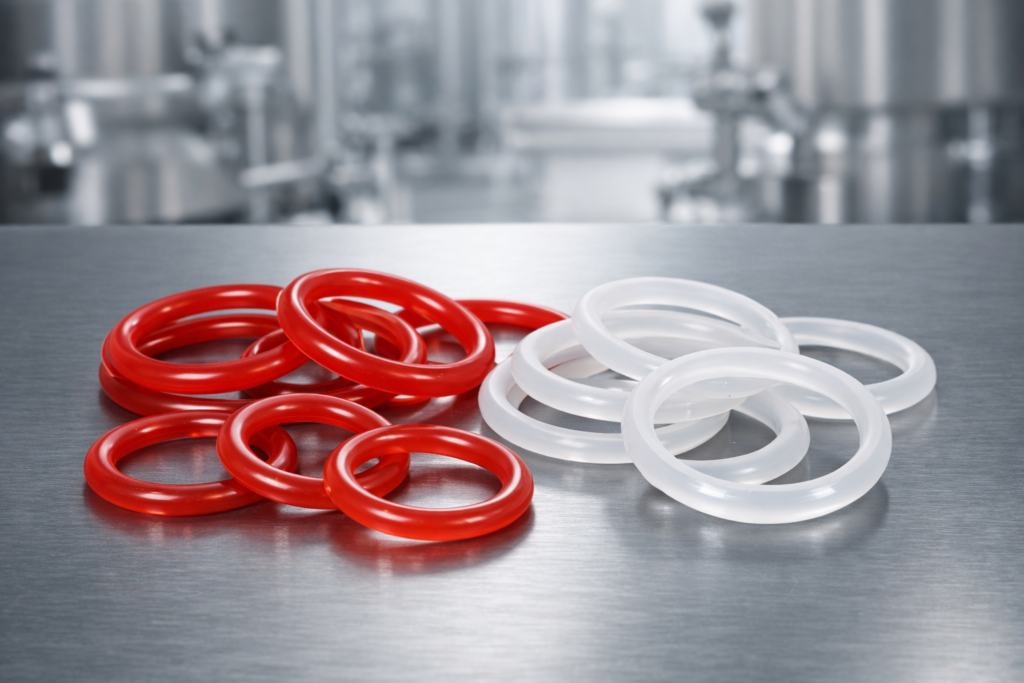
Engineered for Stability and Purity
Silicone O-Rings, also known as VMQ (Vinyl Methyl Silicone), are the preferred choice for applications where thermal stability and physiological inertness are paramount. Unlike standard elastomers, silicone maintains its flexibility and sealing integrity across a vast temperature spectrum.
Thermal Stability
Maintains mechanical properties at temperatures where most elastomers would become brittle or melt.
Physiological Inertness
Odorless, tasteless, and non-toxic, ideal for food-contact and medical-grade applications.
Electrical Insulation
High dielectric strength makes it an excellent choice for electronic enclosures and connectors.
Material Properties & Performance Data
| Property | Standard / Unit | Value (Typical) |
|---|---|---|
| Hardness Range | Shore A | 30 – 90 (Standard: 70) |
| Tensile Strength | MPa | 5.0 – 10.0 |
| Elongation at Break | % | 150% – 600% |
| Temperature Range | °C | -60°C to +230°C |
| Compression Set | 22h @ 175°C | 15% – 30% |
| Certifications | – | FDA, RoHS, REACH, USP Class VI |
Industry-Specific Sealing Solutions
Food & Beverage
FDA-compliant silicone O-rings for commercial ovens, beverage dispensers, and food processing machinery. Resists animal fats and vegetable oils.
Medical & Pharma
USP Class VI certified seals for surgical instruments and fluid delivery systems. Excellent sterilization resistance (Autoclave/EtO).
Aerospace & Electronics
Exceptional resistance to ozone and UV radiation. Standard for outdoor electrical enclosures and ignition systems.
Technical FAQ
Q: What is the difference between VMQ and Silicone?
A: VMQ stands for Vinyl Methyl Silicone, the technical designation for the group of silicone elastomers. The terms are used interchangeably.
Q: Can silicone O-rings be used in dynamic applications?
A: Generally, no. Silicone has low tensile strength and poor abrasion resistance. It is primarily recommended for static sealing.
Q: Are all silicone O-rings food-grade?
A: Not necessarily. Only specific formulations meeting FDA 21 CFR 177.2600 or EC1935/2004 standards are certified for food contact.